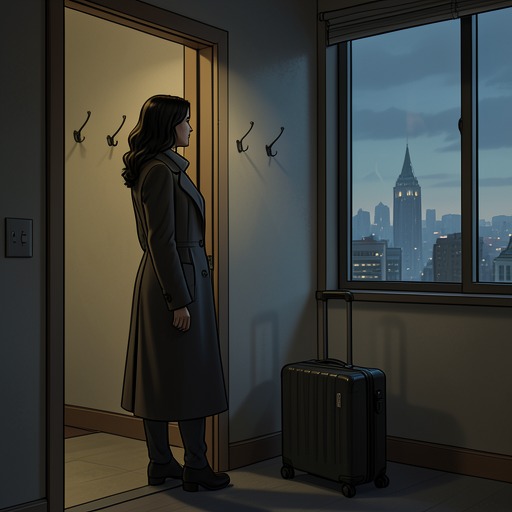
Leah's No-Contact Break with Evan
Roommate Wars & Midnight Kisses (My College Romance)Leah's No-Contact Break with Evan marks the point at which Leah transforms leaving into a durable refusal of contact. Evan's messages and later photographic provocation reopen the emotional script of their past relationship, but Leah ultimately answers without apology, sends a direct rejection, and blocks his number. The event matters because it breaks a pattern in which Evan's pressure made her revise, explain, and doubt her own decisions; Leah's boundary becomes an act of self-definition rather than another negotiation.
First Contact and the Old Pattern
Leah is already living and studying at the University of Michigan when an unknown number reaches her while she is moving between the psychology building and the library. The message identifies her new location and treats her transfer as something Evan has heard about rather than something Leah has chosen for herself. A second message makes the grievance explicit: Evan objects that Leah did not tell him personally and frames her disappearance as an offense against him.
The messages trigger a physical drop of fear followed by anger. Leah understands that she did not disappear; she moved, transferred, and chose herself. Yet the old relational pattern immediately reasserts itself. She drafts replies, deletes them, and searches for wording that will not provoke another argument. Her hesitation is not uncertainty about what she wants so much as conditioning produced by repeated small negotiations: texts rewritten to preserve peace, late-night calls devoted to justifying her choices, and Evan's dismissal that she was overreacting. The unanswered message therefore carries the weight of an entire former structure of control.
The First Boundary
Leah eventually composes a direct request that Evan not contact her again, but even that sentence feels confrontational to her. She imagines the familiar consequence in which a boundary becomes an opening for another argument and she ends up apologizing. The scene's tension lies between recognition and action: Leah can name the pattern, yet naming it does not immediately make the physical act of sending the message easy.
Her decision changes when she accepts that the pattern cannot change while it remains unacknowledged. She exhales and taps the block function. Nothing dramatic follows. The sky does not open, the ground does not swallow her, and her heart does not stop. The understated aftermath gives the boundary its force: freedom arrives not as spectacle but as a tiny alteration beneath Evan's name on a phone screen. Blocking him is consequently both technologically ordinary and emotionally consequential, because it prevents the old cycle from demanding one more explanation.
Evan's Return and Leah's Final Refusal
The no-contact break is tested again when a notification displays Evan's name. Leah nearly refuses to open it, but curiosity wins. The message is accompanied by a photograph of the shabby coffee shop near her former campus, a place associated with nights when the two of them claimed to be studying. Evan's caption invokes remembered intimacy and asks whether she misses “real passion yet?” The image is not neutral nostalgia; it attempts to make a former setting and a former sexual-emotional script speak for the relationship's continuing authority.
The photograph briefly revives the internal script Leah has learned to distrust. She hears the familiar logic that Evan misses her, that no one else will know her as he did, and that perhaps she exaggerated what happened. This time, however, anger is directed outward rather than turned against herself for leaving or staying. Leah recognizes Evan's message as an attempt to treat her present life as a game he can still prod at. That recognition prevents memory from becoming consent.
Leah responds with the single word “No.” She follows it by asking Evan not to text her again, sends the message before she can talk herself out of it, and blocks his number. The sequence is important: the first boundary stalled before sending, whereas the later response is executed before self-doubt can reopen the negotiation. The knot in Leah's stomach loosens after the block, and she places the phone face down. The gesture closes the channel through which Evan has repeatedly tried to regain access to her attention.
Consequences and Narrative Significance
The event establishes that Leah's separation from Evan is not merely geographic or circumstantial. Her transfer to the University of Michigan had already represented a choice to move toward a life of her own, but Evan's messages reveal how easily physical distance can coexist with psychological access. The two blocking decisions make no-contact an active practice: Leah must refuse the demand to explain herself, reject the nostalgia used to lure her back, and accept the discomfort that accompanies an unqualified boundary.
The event also contrasts Evan's language of entitlement with Leah's increasingly economical language of refusal. He speaks through implication, grievance, memory, and the suggestion that their past defines what counts as real passion. Leah begins with elaborate drafts and deleted explanations, then reaches a plain request, and finally answers with “No.” The shrinking response is a formal sign of change. As her words become shorter, her agency becomes less negotiable.
When Leah's number is blocked for the final time, the immediate result is not a grand reconciliation or public victory but bodily relief: the knot in her stomach loosens, and the phone turns face down. That modest ending suits the event's central claim. Leah does not defeat Evan by persuading him to understand; she protects herself by withdrawing the access on which his old influence depends. Leah's No-Contact Break with Evan therefore serves as a foundational act of self-respect, clearing emotional space for the relationships and choices she makes in her new life at the University of Michigan.